
Oculo-Cardiac Reflex in the Emergency Department: Why Is This Head Injury Patient Bradycardic?
An 81-year-old man comes to the emergency department (ED) after a fall.
An 81-year-old man comes to the emergency department (ED) after a fall. He has a head and facial injury, but his vital signs are normal. The specialist teams agree that he can wait for a bed. Then, while he is waiting, his heart rate falls to 25 beats per minute.
What is going on?
Most clinicians think first of raised intracranial pressure or a spinal injury. But there is another cause that is easy to forget in facial trauma: the oculo-cardiac reflex (OCR).
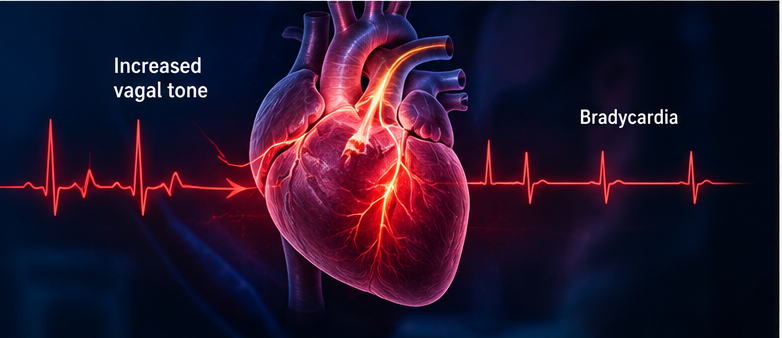
Quick definition: The oculo-cardiac reflex is bradycardia, or a drop in heart rate of more than 20%, that happens when the muscles around the eye are pulled or the eyeball is compressed. The signal travels along the trigeminal nerve and returns through the vagus nerve to slow the heart.
This article is written for emergency doctors, nurses, paramedics, and medical students. It explains how to recognize OCR, how to separate it from more dangerous causes of bradycardia after head and facial injury, and how to treat it in the ED.
A Real Case: Bradycardia After a Fall With Facial Injury
An 81-year-old man arrived at the ED after a mechanical fall with head and facial injuries.
- Past history: diabetes and hypertension, not on anticoagulants
- Vital signs on arrival: all normal
- CT head with facial views: a fracture of the right inferior orbital wall (orbital floor) with a trapped inferior rectus muscle
- Eye examination: hyphema, which is blood in the front part of the eye between the iris and the cornea

The case was discussed with the maxillofacial and ophthalmology teams. Both agreed that nothing needed to be done overnight and that he should be admitted for observation.
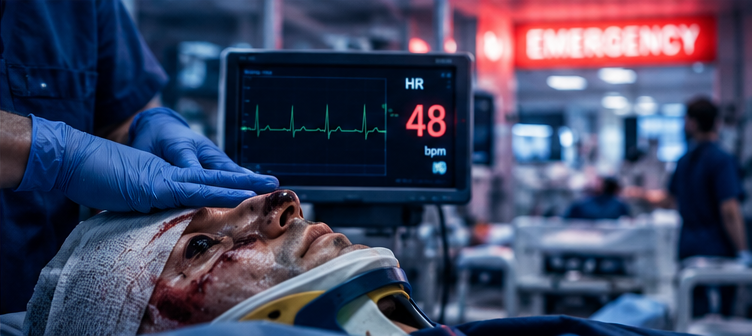
While he waited for a bed, his heart rate suddenly dropped to 25 beats per minute. The ECG showed sinus bradycardia.
Before reading on, ask yourself: which causes of bradycardia must I think of in this patient, and which one fits best?
What Is the Oculo-Cardiac Reflex (OCR)?
OCR was first reported in 1908. You may see it called by other names:
- Trigemino-vagal reflex
- Trigemino-cardiac reflex (TCR)
- Aschner phenomenon or Aschner reflex
Definition
OCR is bradycardia, or a fall in heart rate of more than 20%, linked to traction on the extraocular muscles and/or compression of the eyeball.
What does it look like?
- Most often: sinus bradycardia
- It can also cause low blood pressure
- Other bradyarrhythmias are reported
- In rare cases, cardiac arrest
Who is at higher risk?
The younger the patient, the stronger the reflex. It is far stronger in children. However, as the case above shows, it can still happen in older adults, so age should not make you rule it out.
The Nerve Pathway: Trigeminal Nerve and Vagus Nerve
OCR is a simple reflex arc.
| Part of the arc | What happens |
|---|---|
| Trigger | Traction on the eye muscles or pressure on the globe |
| Afferent (input) | Signal travels through the trigeminal nerve (cranial nerve V) to the brainstem |
| Relay | Brainstem connections link the trigeminal nuclei to the vagal nuclei |
| Efferent (output) | Signal travels through the vagus nerve (cranial nerve X) to the heart |
| Result | Slower sinoatrial node firing and slower AV node conduction, causing bradycardia |
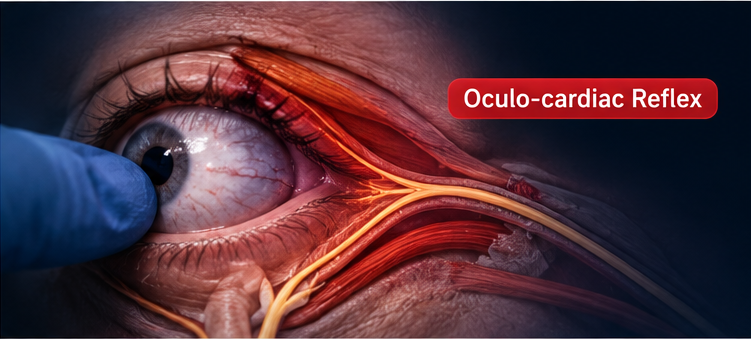
Why this matters for treatment: The output of the reflex is vagal. That is why anticholinergic drugs such as atropine and glycopyrrolate can reverse it.
Bradycardia With Head and Facial Injuries: Differential Diagnosis
Never assume that bradycardia after head or facial trauma is a harmless reflex. Think about the dangerous causes first.
The three key causes to rule out
| Cause | Mechanism | Typical picture |
|---|---|---|
| Cushing reflex (raised intracranial pressure) | Raised ICP compresses the brainstem and activates the vagus | Bradycardia + hypertension + irregular breathing |
| Severe hypoxia | Low oxygen suppresses the heart muscle | Bradycardia with low SpO₂, airway or breathing problem |
| Cervical spine injury (spinal cord injury above T1) | Loss of sympathetic tone leaves vagal activity unopposed (neurogenic shock) | Bradycardia + hypotension, possible neurological deficit |
Other causes to keep in mind
Especially in older patients:
- Medicines: beta-blockers, calcium channel blockers, digoxin, and others
- Heart conduction disease or heart attack (check the ECG)
- Electrolyte and metabolic problems: for example high potassium or low glucose
- Hypothermia
A quick bedside approach
| Ask yourself | Points toward |
|---|---|
| Is the blood pressure high with irregular breathing and falling consciousness? | Cushing reflex, so urgent neurosurgical input and repeat CT |
| Is the blood pressure low with a possible spinal injury? | Neurogenic shock |
| Is the oxygen level low or the airway at risk? | Hypoxia, so treat first |
| Is there eye or orbital injury with muscle entrapment or pressure on the globe, and no other cause? | Oculo-cardiac reflex |
OCR in Facial Trauma: Why It Is Easy to Miss
OCR is usually taught in the setting of eye surgery, but it can also be triggered by trauma. The lesson from the case above is simple:
Consider OCR in any patient with facial trauma, particularly an orbital fracture with a trapped eye muscle, or pressure on the globe.
Points to remember:
- Normal vital signs on arrival do not exclude it. The reflex can start later, when the muscle is pulled or the eyeball is compressed.
- Entrapment keeps the trigger active. In surgery, the surgeon can release the traction. In a trapped muscle, the stimulus may not go away on its own.
- Always examine the eye. Look for restricted eye movement (especially upward gaze), double vision, and eye injuries such as hyphema.
- Do not forget the other causes listed above. OCR is a diagnosis you make after you have considered the dangerous ones.
- If bradycardia keeps coming back with an entrapped muscle, re-discuss the case urgently with the maxillofacial and ophthalmology teams.
Treatment of the Oculo-Cardiac Reflex in the ED
Treatment has three parts.
1. Stop the stimulus
Remove the traction on the eye muscles or the pressure on the globe. In surgery this is easy. In trauma with a trapped muscle it may not be possible, and this is why drug treatment may be needed.
2. Give an anticholinergic drug
Atropine and glycopyrrolate block the effect of the vagus nerve on the heart. See the comparison table in the next section.
3. Be careful with certain drugs
- Avoid strong opioids such as morphine and fentanyl. They can increase vagal tone and make the bradycardia worse.
Supportive care while you treat
- Continuous ECG, blood pressure, and oxygen saturation monitoring
- Give oxygen if the saturation is low
- Have resuscitation equipment and drugs ready
- If the patient becomes pulseless, start standard advanced life support according to local guidelines
Atropine vs Glycopyrrolate: Which One to Choose?
Both are anticholinergic drugs that can reverse vagal bradycardia. They differ in how long they last and where they act.
Comparison table
| Feature | Atropine | Glycopyrrolate |
|---|---|---|
| Chemical type | Tertiary amine | Quaternary ammonium |
| Typical adult IV dose | 1 mg, repeated every 3–5 minutes up to 3 mg (standard ACLS bradycardia dosing) | 0.2–0.4 mg IV, repeated as needed, usually every 2–3 minutes |
| Onset (IV) | About 1 minute | 1–2 minutes |
| Peak effect | Within a few minutes | About 5 minutes |
| Duration | Shorter | 2–4 hours (longer than atropine) |
| Crosses the blood–brain barrier | Yes | No |
| Central nervous system side effects | Possible (confusion, agitation, delirium), especially in older adults | Avoided |
| Effect on the pupil and aqueous humor outflow | Can dilate the pupil and affect outflow | Minimal |
| Best fit | Fast, severe bradycardia with poor perfusion | Older patients, risk of delirium, eye injury or raised intraocular pressure |
Doses are general references only. Always check your local protocol, the patient's weight, and your drug reference before giving any medicine.
Why glycopyrrolate suited this case
For our patient, glycopyrrolate had three advantages:
- He had an eye injury (hyphema), and glycopyrrolate has minimal effect on pupil size and on aqueous humor outflow. It is the preferred vagolytic when intraocular pressure is a concern.
- He was 81 years old, so avoiding the central nervous system effects of atropine was an advantage.
- He had a head injury, so avoiding drugs that cloud the neurological picture is helpful. Pupil size is often used to monitor head injury, and glycopyrrolate has minimal effect on it.
Atropine is still a valid and widely used choice, especially when speed is critical.
Back to the Case
| Question | Answer in this patient |
|---|---|
| What caused the bradycardia? | Oculo-cardiac reflex from the trapped inferior rectus muscle in the orbital floor fracture, after other causes were considered |
| Stop the stimulus? | Not possible in the ED because the muscle was trapped |
| Drug of choice | Glycopyrrolate (anticholinergic, preferred with an eye injury and in an older patient) |
| What to avoid | Strong opioids such as morphine and fentanyl |
Frequently Asked Questions
What is the oculo-cardiac reflex in simple words?
It is a drop in heart rate caused by pulling on the eye muscles or pressing on the eyeball. The trigeminal nerve carries the signal to the brain, and the vagus nerve slows the heart.
Can facial trauma cause the oculo-cardiac reflex?
Yes. It can happen with orbital fractures, especially when an eye muscle such as the inferior rectus is trapped, or when there is pressure on the globe.
What is the difference between OCR and the Cushing reflex?
Both cause bradycardia. In the Cushing reflex, bradycardia comes with high blood pressure and irregular breathing because of raised intracranial pressure. OCR follows eye muscle traction or globe pressure. Because the Cushing reflex is life-threatening, it must be excluded.
How do you treat the oculo-cardiac reflex?
Stop the stimulus if possible, then give an anticholinergic drug such as atropine or glycopyrrolate. Avoid strong opioids such as morphine and fentanyl. If sedation is needed, propofol is the agent of choice.
Why avoid morphine and fentanyl in OCR?
They can increase vagal tone, which can make the bradycardia worse.
Is glycopyrrolate better than atropine for OCR?
It depends on the situation. Glycopyrrolate lasts longer, does not cross the blood–brain barrier, and has minimal effect on the pupil and aqueous humor outflow. That makes it a good choice when the intraocular pressure is a concern. Atropine acts quickly and is a standard choice in urgent bradycardia.
Who gets the strongest oculo-cardiac reflex?
Children. The younger the patient, the stronger the reflex, but older adults can also be affected.
Can OCR cause cardiac arrest?
Rarely, yes. Cardiac arrest has been reported, so OCR should always be taken seriously.
Key Learning Points
- OCR is bradycardia (a fall in heart rate of more than 20%) caused by traction on the eye muscles or pressure on the globe, through the trigeminal-vagal reflex arc.
- Consider it in facial trauma, especially an orbital fracture with a trapped eye muscle, even if vital signs were normal on arrival.
- Rule out the Cushing reflex, hypoxia, and cervical spine injury first.
- Treat by stopping the stimulus if possible and giving an anticholinergic drug. Glycopyrrolate is a good choice with eye injury and in older patients.
- Avoid strong opioids such as morphine and fentanyl. Use propofol or midazolam if sedation is needed.
Watch the video: Watch this case on YouTube
Ready To Take Your Clinical Learning Further?
Explore structured ECG and emergency medicine courses built around practical clinical knowledge, real cases, and confident decision-making.