
Stellate Ganglion Block in Cardiac Arrest Management: Current Evidence and Clinical Protocol | From Zero to Hero
Stellate Ganglion Block in Cardiac Arrest Management: Current Evidence and Clinical Protocol | From Zero to Hero
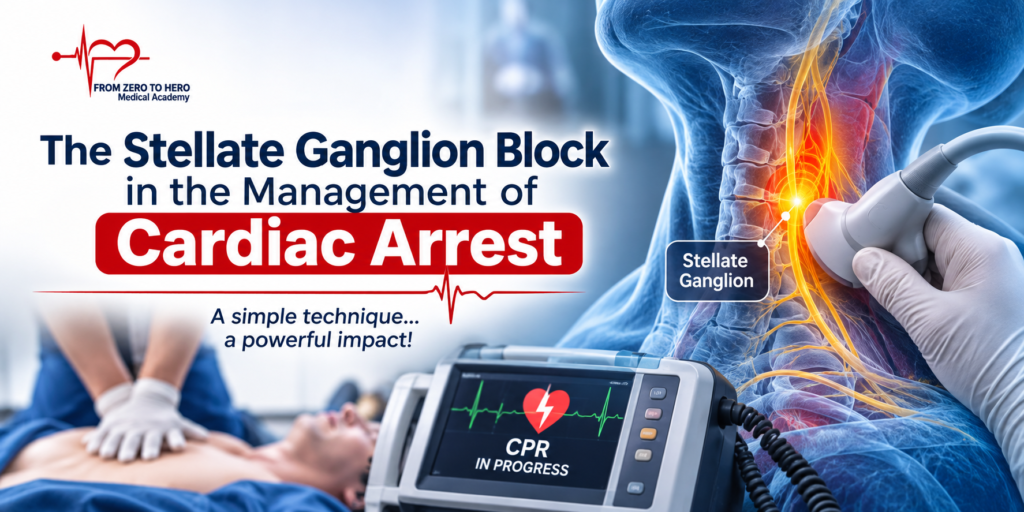
Introduction
Some patients stay in ventricular fibrillation (VF) even after repeated shocks, amiodarone and epinephrine. This is called refractory VF.
One idea is to calm the nervous system that drives the heart. This is sympathetic blockade, and the stellate ganglion block is one way to do it.
In this article you will learn:
- What the stellate ganglion is
- How it affects ventricular arrhythmias
- How SGB works
- What the evidence shows, and what it does not
For more resuscitation topics, explore emergency medicine content on From Zero to Hero.
What Is the Stellate Ganglion?
The stellate ganglion is a cluster of sympathetic nerve cells in the lower neck.
- Formation: usually the fusion of the inferior cervical ganglion and the first thoracic ganglion.
- Location: in front of the neck of the first rib, near the C7 transverse process.
- Neighbors: vertebral artery, pleural dome, carotid sheath.
- Another name: cervicothoracic ganglion.
Cardiac Sympathetic Innervation and Ventricular Arrhythmias
How sympathetic signals reach the heart
The sympathetic nerves to the heart start in the spinal cord, mainly at T1 to T4 (sometimes C8 to T5).
- Nerve fibers leave the spinal cord and travel up the sympathetic chain.
- They connect with nerve cells in the cervical and upper thoracic ganglia.
- The stellate ganglion is a key stop on this pathway.
- From there, fibers travel through the cardiac nerves to the atria, ventricles and conduction system.
Right side versus left side
| Side | Main area supplied | Clinical meaning |
|---|---|---|
| Right | Sinoatrial (SA) node and front wall of the ventricles | Affects heart rate more |
| Left | Atrioventricular (AV) node and back and lower walls of the ventricles | Affects ventricular electrical stability more |
Why too much sympathetic activity is dangerous
High sympathetic activity makes the ventricles electrically unstable:
- Cells recover faster between beats (shorter refractory period).
- Recovery becomes uneven across the ventricles.
- Abnormal extra beats (afterdepolarizations) become more likely.
- Ischemic or scarred heart muscle is even more vulnerable.
How SGB Reduces Sympathetic Stimulation and Electrical Instability
SGB places local anesthetic around the ganglion. This temporarily blocks sympathetic signals to the heart.
Effects of left SGB (mostly from animal studies)
- Longer refractory period: heart cells take longer to recover before they can fire again.
- Higher VF threshold: more stimulation is needed to trigger VF.
- More uniform repolarization: less electrical instability across the ventricles.
- Less noradrenaline release: reduces calcium overload and abnormal electrical activity.
Right-sided blockade has less effect on the ventricles and may slow the heart rate. That can be undesirable after cardiac arrest.
An important distinction
| Concept | Meaning | Effect of left SGB |
|---|---|---|
| VF threshold | How easily the heart starts fibrillating | Appears to increase it |
| Defibrillation threshold | Minimum energy needed to stop VF | Reduction not convincingly shown in humans |
Some patients are defibrillated successfully after SGB. This does not prove the block caused it. CPR, drug circulation and coronary blood flow may also contribute.
Effects on Myocardial Oxygen Demand and Catecholamine-Driven Proarrhythmia
Oxygen demand
- In a heart that still has output, sympathetic blockade lowers heart rate and contractility.
- Lower workload means lower oxygen demand.
- During CPR, this benefit is less clear, because the heart is not pumping.
The adrenaline paradox
During a long arrest, three things push the sympathetic system higher:
- The body releases adrenaline in response to ischemia.
- Repeated epinephrine doses are given during resuscitation.
- Sympathetic nerves keep stimulating the heart.
Together, these effects make the heart more unstable. The drug we use most often may also keep the heart harder to defibrillate.
Evidence Supporting SGB in Refractory VF and Electrical Storm
Electrical storm means three or more episodes of sustained VT or VF within 24 hours.
Evidence in electrical storm (strongest data)
| Study | Type | Main finding |
|---|---|---|
| Fudim et al., 2017 | Systematic review and meta-analysis | Supported left-sided or bilateral SGB for refractory ventricular arrhythmias. Data were observational; randomized trials needed. |
| STAR study, 2024 | Prospective multicenter study | SGB added to standard care reduced arrhythmia in electrical storm. |
| Motazedian et al., 2024 | Meta-analysis (15 studies, 542 patients) | About 70% had complete resolution of ventricular arrhythmia. |
Evidence during cardiac arrest (limited data)
- Case report: Margus et al., Annals of Emergency Medicine, 2020. Ultrasound-guided SGB for refractory VF after standard and double sequential defibrillation, epinephrine, amiodarone, magnesium and bicarbonate had failed.
- Case series: Two cases of refractory pulseless VT treated with SGB (Journal of Emergency Medicine, 2023).
- Scoping review: 32 intra-arrest cases. The block was feasible during CPR and often followed by successful defibrillation. The authors noted publication bias.
- Ongoing trial: LIVE study (NCT04168970), a prehospital randomized trial of SGB in out-of-hospital cardiac arrest.
What the Evidence Does and Does Not Prove
| The evidence supports | The evidence does not prove |
|---|---|
| SGB is feasible during CPR in trained hands | That SGB improves survival or ROSC |
| SGB reduces arrhythmia burden in electrical storm | That storm results apply to pulseless arrest |
| Left SGB raises the VF threshold in experimental models | That SGB lowers the defibrillation threshold in humans |
| Defibrillation often succeeded after the block in reported cases | That the block caused the success |
Why caution is needed
- Most data are case reports and series.
- Successful cases are more likely to be published.
- No randomized trial in cardiac arrest has been completed yet.
- Risks exist: vascular injury, hematoma, local anesthetic toxicity, and phrenic or laryngeal nerve block.
For current resuscitation recommendations, check the AHA guidelines and the primary literature on PubMed.
Conclusion
- The stellate ganglion carries sympathetic signals to the heart.
- Too much sympathetic activity promotes ventricular arrhythmias.
- Left SGB raises the VF threshold and stabilizes ventricular repolarization.
- Evidence is strongest in electrical storm and weak in cardiac arrest.
- Randomized data are still awaited.
Visit From Zero to Hero for more critical care and emergency medicine insights.
Frequently Asked Questions
What is a stellate ganglion block?
It is an injection of local anesthetic near the stellate ganglion in the lower neck. It temporarily blocks sympathetic nerve signals to the heart and is usually guided by ultrasound.
Why is the left side usually blocked in refractory VF?
Left-sided sympathetic fibers mainly supply the ventricles and AV node. Right-sided fibers mainly supply the SA node, so right blockade affects heart rate more than ventricular stability.
Does SGB lower the defibrillation threshold?
Not proven in humans. Left SGB appears to raise the VF threshold, meaning the heart is harder to push into fibrillation. Success after the block may also reflect CPR, drugs and other factors.
Is SGB recommended in ACLS guidelines for cardiac arrest?
No. It is considered a rescue option supported by case reports and indirect electrical storm data. Randomized trials such as LIVE are ongoing.
Ready To Take Your Clinical Learning Further?
Explore structured ECG and emergency medicine courses built around practical clinical knowledge, real cases, and confident decision-making.