
When to Use Stellate Ganglion Block: Patient Selection in Refractory VF, Pulseless VT and Electrical Storm
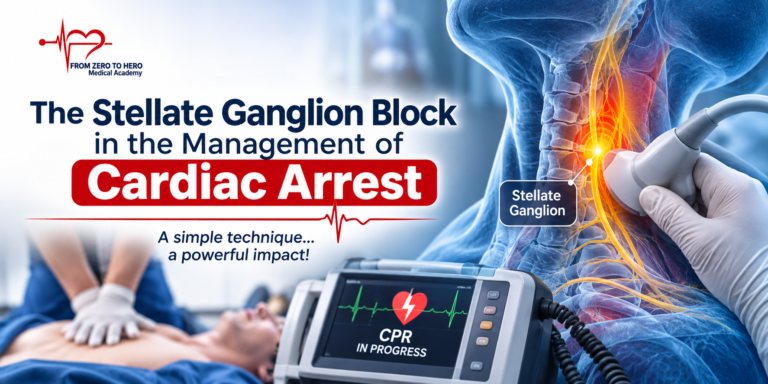
When to Use Stellate Ganglion Block: Patient Selection in Refractory VF Introduction Knowing how to perform a stellate ganglion block is only half the question. The harder question is when. This article helps you…

Introduction
Knowing how to perform a stellate ganglion block is only half the question. The harder question is when.
This article helps you decide:
- Which patients may benefit
- When to consider SGB during cardiac arrest
- How electrical storm differs from pulseless arrest
- Where SGB fits among ALS, DSED, ECPR and ablation
- How to coordinate with the team
For the mechanism and evidence behind SGB, see our companion article, and explore more emergency resuscitation protocols on From Zero to Hero.
Definition of Refractory VF and Pulseless VT
There is no single agreed definition. A common working definition is:
- VF or pulseless VT that persists after 3 or more shocks
- Plus an antiarrhythmic (amiodarone or lidocaine)
- Plus epinephrine as per ACLS
Related terms:
| Term | Meaning |
|---|---|
| Refractory VF/pVT | Shockable rhythm persists despite standard ALS |
| Recurrent VF | VF returns after a period of successful defibrillation |
| Electrical storm | 3 or more episodes of sustained VT/VF within 24 hours, separated by at least 5 minutes |
Check your own protocol. Definitions vary between guidelines and studies.
When to Consider SGB During Cardiac Arrest
SGB is a late rescue step. It comes after the basics are done and working.
Before considering SGB, confirm
- High-quality CPR is running with minimal pauses
- Shocks have been delivered with correct pad position
- Epinephrine and an antiarrhythmic have been given
- Reversible causes (the H's and T's) have been looked for
- Airway and vascular access are secured
Then consider SGB if
- VF/pVT persists after 3 or more shocks and an antiarrhythmic
- DSED or vector change has been tried or is not available
- A trained operator and an ultrasound machine are ready
- A second person can run the block without disturbing CPR
Patient Selection and Practical Triggers
Patients who may be better candidates
- Suspected ischemic cause (acute MI was the most common cause in reported cases)
- Known cardiomyopathy or structural heart disease
- Recurrent VF after multiple shocks
- Witnessed arrest with a shockable rhythm from the start
- Patients awaiting ECPR, cath lab or ablation, where a bridge is needed
Practical triggers
| Trigger | Action |
|---|---|
| 3 shocks plus antiarrhythmic, VF persists | Call for the SGB operator and ultrasound |
| DSED or vector change fails | Perform SGB while CPR continues |
| ECPR or cath lab being arranged | Perform SGB while waiting for transfer |
| Recurrent VF after ROSC | Consider SGB to reduce further episodes |
When to avoid or delay SGB
- CPR quality would suffer
- No trained operator or no ultrasound
- Distorted neck anatomy, local infection or neck hematoma risk (for example, anticoagulation)
- Known contralateral phrenic or recurrent laryngeal nerve palsy
- Reversible cause not yet treated
In an arrest, most contraindications are relative. Weigh them against the risk of ongoing VF.
SGB in Electrical Storm: Indications and Evidence
Indications
- Electrical storm that continues despite beta-blockers, amiodarone or lidocaine
- Repeated ICD shocks or repeated external shocks
- Patient awaiting catheter ablation or other definitive treatment
- Patient who cannot tolerate antiarrhythmic drugs
Guidelines mention autonomic modulation in this setting, but only with a weak (class IIb) recommendation.
Evidence
| Study | Finding |
|---|---|
| STAR study, 2024 | SGB added to standard therapy reduced arrhythmia in electrical storm |
| Motazedian et al., 2024 (15 studies, 542 patients) | About 70% had complete resolution of ventricular arrhythmia |
| Fudim et al., 2017 | Supported left-sided or bilateral SGB; data were observational |
Continuous SGB through a catheter has also been described for storm that returns after a single injection.
Electrical Storm Versus Pulseless Cardiac Arrest
| Feature | Electrical storm | Pulseless refractory VF/pVT |
|---|---|---|
| Circulation | Often present, possibly unstable | Absent; CPR in progress |
| Time available | Hours | Minutes |
| Procedure conditions | Controlled, patient can be positioned | Moving neck and shoulders during compressions |
| Main goal | Reduce episodes, bridge to definitive therapy | Help terminate VF and achieve ROSC |
| Strength of evidence | Prospective studies and meta-analyses | Case reports, small series, scoping review |
| Repeat or continuous block | Possible | Rarely relevant during the arrest |
Do not assume that storm results apply directly to pulseless arrest. They support the idea, but they do not prove it.
Where SGB Fits in the Treatment Pathway
| Option | Role | Where SGB fits |
|---|---|---|
| Standard ALS | CPR, shocks, epinephrine, amiodarone or lidocaine | SGB is never a substitute for these |
| DSED / vector change | Better shock delivery; the DOSE-VF trial (NEJM 2022) reported better survival to discharge | Try first, since it has better evidence. SGB can follow or run in parallel |
| Esmolol | Beta-blockade of circulating catecholamines | Complementary: SGB does not block circulating epinephrine |
| ECPR | Mechanical circulation in selected patients | SGB can be done while ECPR is being prepared; it must never delay activation |
| Cath lab | Treat acute ischemia | SGB is a bridge, not a replacement |
| Catheter ablation / cardiac sympathetic denervation | Definitive treatment for storm | SGB is temporary; it buys hours |
Timing and Coordination With the Resuscitation Team
Suggested team roles
- Team leader: decides to proceed and controls timing
- Compressor: maintains high-quality CPR
- SGB operator: performs the block under ultrasound
- Assistant: stabilizes the head, prepares drugs
- Airway and drug nurse: tracks doses, including total lidocaine given
Practical points
- Prepare the kit early: linear probe, sterile cover, needle, local anesthetic, lipid emulsion nearby.
- Do not stop compressions just to perform the block.
- Inject at a visible needle tip, in small aliquots with aspiration.
- Check the rhythm at the normal 2-minute cycle.
- Record time, side, drug, volume and rhythm response.
- After ROSC, look for Horner's syndrome, neck hematoma and nerve palsy.
Safety reminder
Local anesthetic from the block adds to any IV lidocaine already given. Track the total dose.
Conclusion
- Use SGB only after standard ALS has been optimized.
- Consider it for refractory VF/pVT, especially with a suspected ischemic or structural cause.
- Evidence is stronger in electrical storm than in cardiac arrest.
- It complements DSED, esmolol, ECPR and ablation; it does not replace them.
- A trained operator and a coordinated team are essential.
Read the current AHA guidelines and the primary literature on PubMed. For more, visit From Zero to Hero for critical care and emergency medicine insights.
Frequently Asked Questions
When should I consider a stellate ganglion block in cardiac arrest?
Consider it when VF or pulseless VT persists after 3 or more shocks and an antiarrhythmic, CPR quality is good, and a trained operator is available. It should never delay compressions, shocks or ECPR activation.
How is electrical storm different from refractory VF arrest?
Electrical storm means 3 or more sustained VT/VF episodes within 24 hours, often with some circulation. Refractory VF arrest is pulseless and ongoing. SGB evidence is stronger in storm.
Should I try DSED before SGB?
Yes, usually. DSED and vector change have randomized trial support. SGB is a later rescue option that can follow them or be done in parallel by a second operator.
Does SGB replace ablation or ECPR?
No. SGB is temporary and acts as a bridge. Definitive treatment still depends on the cause, such as revascularization, ablation or mechanical support.

Ready To Take Your Clinical Learning Further?
Explore structured ECG and emergency medicine courses built around practical clinical knowledge, real cases, and confident decision-making.