
Why Case-Based Emergency Medicine Education Works
Case-based learning helps emergency clinicians retain knowledge, practise judgement, and apply frameworks under pressure.
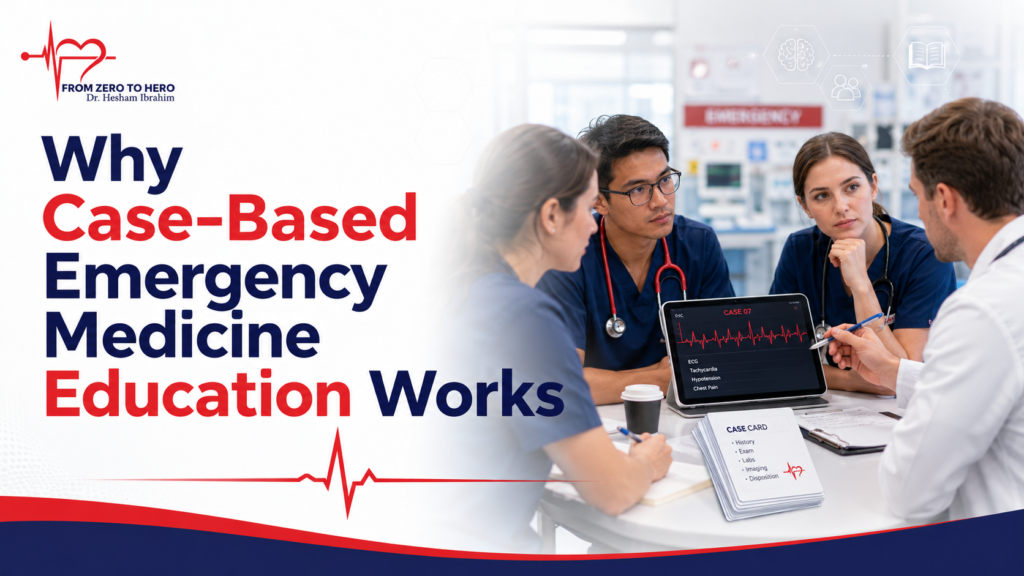
Emergency medicine is built around real patients, incomplete information, time pressure, and risk. A clinician rarely receives a clean textbook presentation. Instead, they meet a patient with symptoms, vital signs, ECG changes, uncertainty, and competing priorities.
This is why case-based education works so well in emergency medicine. It mirrors the way clinicians actually think and act in practice.
Emergency Medicine Is Pattern Recognition Plus Clinical Context
In the emergency department, decisions are not made from one data point. A single ECG, blood test, or symptom rarely gives the full answer. Clinicians need to combine multiple clues quickly and safely.
Case-based learning helps by placing clinical information inside a realistic scenario. Instead of asking, “What does this ECG show?” it asks, “What does this ECG mean in this patient, right now?”
The goal is not only to recognise a diagnosis. The goal is to make the right clinical decision at the right time.
Cases Help Clinicians Remember Better
Facts are easier to forget when they are learned in isolation. But when knowledge is attached to a patient story, it becomes easier to recall.
A clinician may forget a long list of ECG criteria, but they are more likely to remember a case where a subtle ECG change changed the diagnosis, triggered urgent action, or prevented a dangerous miss.
Case-Based Learning Improves Decision-Making Under Pressure
Emergency medicine requires decisions before every detail is available. That makes clinical reasoning especially important.
Good case-based teaching allows learners to practise:
- Identifying the most important clinical problem.
- Recognising red flags early.
- Interpreting investigations in context.
- Choosing safe next steps.
- Reflecting on what could be missed.
It Teaches Uncertainty, Not Just Answers
Many traditional teaching formats present the diagnosis too early. Real emergency medicine does not work like that. Clinicians must often manage uncertainty while keeping the patient safe.
Case-based education allows learners to pause at key decision points and ask: What are we worried about? What would change management? What should not be missed?
It Connects Knowledge to Action
The best emergency medicine education does not stop at diagnosis. It links interpretation to action.
For example, an ECG case should not only explain the rhythm or ST segment changes. It should also explain what the clinician should do next, who should be involved, and why the timing matters.
Clinical education becomes more powerful when it moves from “What is it?” to “What should we do now?”
Why This Matters for ECG Education
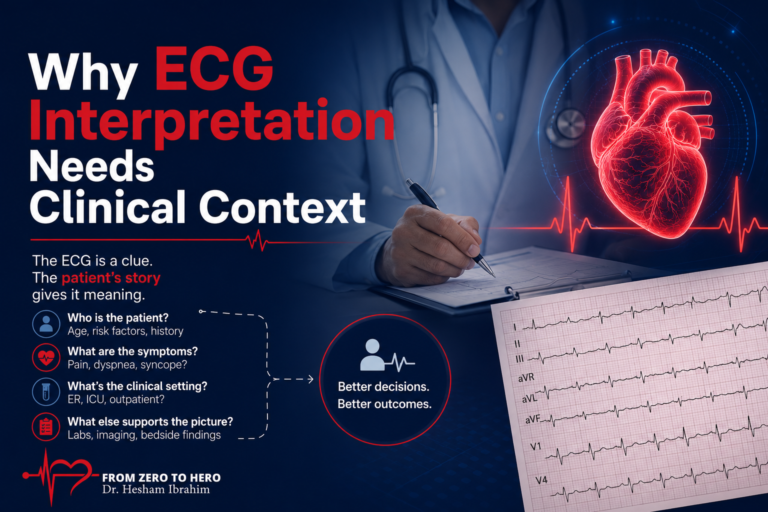
ECG interpretation is one of the best examples of why clinical context matters. The same ECG pattern can have different implications depending on symptoms, haemodynamics, risk factors, and timing.
Case-based ECG learning helps clinicians develop safer habits. It encourages them to interpret the ECG as part of the patient story, rather than as an isolated image.
Final Thought
Case-based emergency medicine education works because it respects the reality of clinical practice. It teaches knowledge, but also judgement. It improves recognition, but also decision-making. Most importantly, it helps clinicians practise the kind of thinking they need when the next real patient arrives.
Ready To Take Your Clinical Learning Further?
Explore structured ECG and emergency medicine courses built around practical clinical knowledge, real cases, and confident decision-making.