
A Safer Mindset for ACS ECG Learning
ACS ECG learning is not only about obvious STEMI. It is about structured review, subtle signs, repeated assessment, and safer escalation thinking.

Acute coronary syndrome ECG interpretation can look straightforward when it is taught through classic textbook patterns. A clear-cut tracing is easy to recognise once the diagnosis is already obvious.
Real emergency practice is different. The patient may present early. Symptoms may be atypical. The ECG may show only subtle abnormalities. The first test may not give you a complete answer. Sometimes the most important decision is recognising that the available information is not reassuring enough.
The aim is not simply to label the ECG. The aim is to recognise whether the patient and the tracing together suggest a potentially time-sensitive coronary problem that needs further assessment or escalation.
Start With The Clinical Story
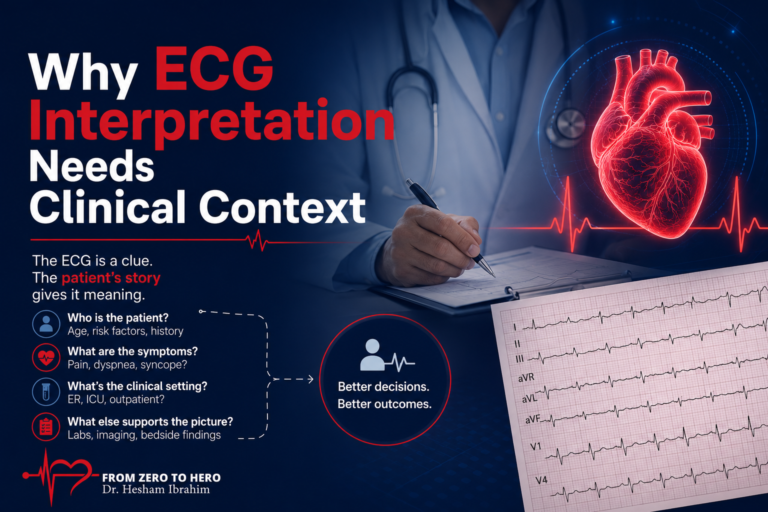
A safer approach starts before detailed ECG interpretation. The tracing should be understood in the context of the patient in front of you.
Before asking whether the ECG meets a specific pattern or threshold, consider:
- Does the symptom pattern raise concern for myocardial ischaemia?
- Are symptoms ongoing, recurrent, or changing?
- Is the patient haemodynamically or clinically unstable?
- Are there features that increase the pre-test concern?
- Does the ECG actually fit the clinical picture?
An ECG that appears relatively reassuring cannot completely override a concerning history or evolving clinical picture.
Look For Risk, Not Only Formal Criteria
Formal ECG criteria are important, but they should not become the only way a clinician recognises danger.
A more clinically useful question is: could this tracing represent acute or evolving coronary ischaemia even if it does not look like a classic STEMI?
This mindset reduces the risk of dismissing a tracing simply because the abnormalities are subtle, incomplete, or do not fit a memorised pattern perfectly.
Serial Change Can Be More Important Than A Single ECG
A single ECG is only one moment in time. Acute coronary syndromes can evolve, and the tracing may evolve with them.
When symptoms remain concerning, repeated ECG assessment and comparison with previous tracings can reveal changes that were not obvious initially.
The key learning point is simple: do not treat the first ECG as the end of the diagnostic process when the clinical situation is still changing.
Subtle Patterns Deserve Attention
Some high-risk coronary presentations are missed because the ECG does not appear dramatic. Important abnormalities may be small, regional, dynamic, or easier to recognise when compared with a previous tracing.
Examples commonly discussed in ACS ECG education include posterior infarction patterns, hyperacute T-wave changes, de Winter pattern, Wellens pattern, reciprocal change, and other forms of subtle ST-T abnormality.
The question is not only “Is there ST elevation?” A safer question is: “Is there evidence here that should increase my concern for acute coronary ischaemia?”
Avoid False Reassurance
One of the most important cognitive traps in ACS assessment is allowing a relatively reassuring-looking ECG to reduce concern too early.
Patients can look well. Symptoms can be non-classic. The tracing may not satisfy a familiar pattern. None of those features, by themselves, necessarily make the patient low risk.
Good ECG interpretation therefore includes recognising when the tracing does not explain away the clinical concern.
Use Uncertainty To Trigger Reassessment
In emergency medicine, uncertainty should usually lead to further thinking rather than premature closure.
Depending on the clinical context, that may include:
- Repeating the ECG when symptoms continue or change.
- Comparing the tracing with previous ECGs.
- Looking deliberately for reciprocal abnormalities.
- Considering additional leads when clinically appropriate.
- Reassessing the patient rather than interpreting the ECG in isolation.
- Escalating early when the overall picture remains concerning.
Move From Pattern Recognition To Clinical Reasoning
Memorising ECG patterns is useful, but it is not the final goal.
The more transferable skill is learning how to combine the tracing with symptoms, timing, serial change, risk, and clinical trajectory.
That is what turns ECG knowledge into safer clinical decision-making.
Key Learning Points
- Interpret the ECG in clinical context.
- Do not rely only on classic criteria.
- Look for serial and reciprocal change.
- Respect subtle high-risk patterns.
- Use uncertainty as a reason to reassess.
Final Thought
A safer mindset for ACS ECG learning means accepting that not every dangerous presentation arrives with a dramatic tracing.
The goal is to recognise concerning patterns early, notice when the ECG and the patient do not fit together, reassess when uncertainty remains, and avoid false reassurance.
In other words, the value of ECG learning is not simply knowing more patterns. It is being able to apply that knowledge when the clinical situation is incomplete, evolving, and time-sensitive.

Ready To Take Your Clinical Learning Further?
Explore structured ECG and emergency medicine courses built around practical clinical knowledge, real cases, and confident decision-making.