
Your Medical Portfolio Is More Than Just a Folder
If you are a doctor working in the UK, there is a good chance you have already heard the word “portfolio” more times than you would like. Certificates. Reflections. Assessments. Feedback. Audits. Teaching. Courses.…
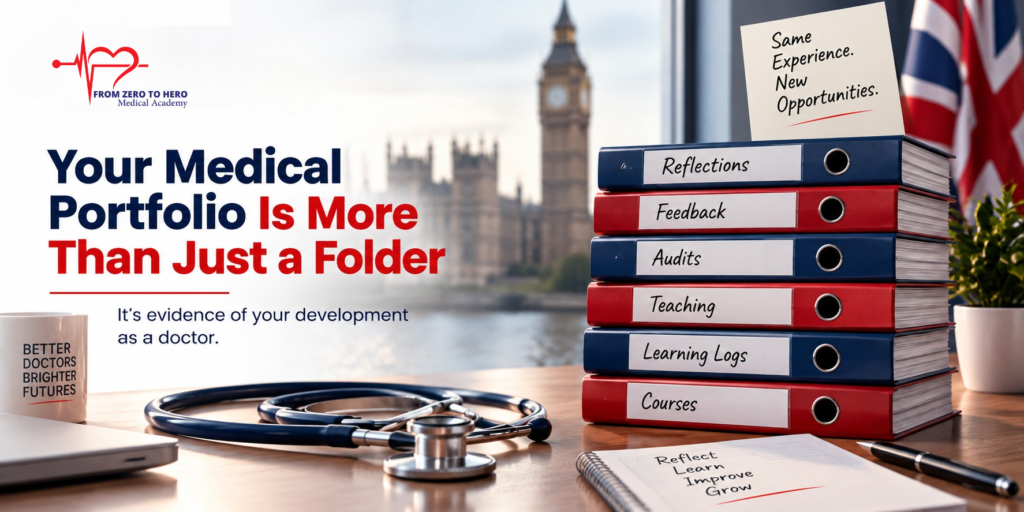
If you are a doctor working in the UK, there is a good chance you have already heard the word “portfolio” more times than you would like.
And somehow, all of this needs to go somewhere.
For many doctors, especially those new to the UK, the portfolio can initially feel like another administrative burden.
But after working through different portfolio systems during my own medical career, I have come to see it very differently.
Your portfolio is not a folder full of documents. It is evidence of your development as a doctor.
And that distinction matters.
Don’t collect evidence just for the sake of it
One of the easiest traps to fall into is thinking:
“I need more certificates.”
So you attend another course.
Then another webinar.
Then another conference.
Your portfolio gets bigger, but does it actually get better?
Not necessarily.
A certificate might show that you attended a course.
It doesn’t necessarily show what you learned, how it changed your practice or how you developed as a result.
A meaningful reflection, useful feedback from a colleague, or evidence that you identified a problem and helped improve it may tell a much stronger story.
The question should therefore not always be:
“What can I upload?”
Instead ask:
“What does this evidence demonstrate about me?”
Your portfolio should tell your story
Imagine somebody who doesn’t know you opens your portfolio.
What would they see?
Would they simply see a collection of certificates?
Or would they see a doctor who is:
- developing clinically
- learning from experience
- responding to feedback
- contributing to teaching
- improving services
- developing leadership skills
- recognising areas for further development
That is the real value of a portfolio.
It gives you an opportunity to demonstrate things that a CV alone cannot.
Your CV might say:
“I have teaching experience.”
Your portfolio can show the teaching you have done, feedback you received, what you learned and how your approach developed.
Your CV might say:
“I have participated in quality improvement.”
Your portfolio can demonstrate the actual project and, more importantly, what changed as a result.
And this is where IMGs can struggle
For an IMG, there is an additional challenge.
You may already have years of experience before arriving in the UK.
You may have worked as a senior doctor.
You may have taught students.
You may have undertaken audits or research.
You may have led teams or departments.
That experience doesn’t suddenly become irrelevant because you crossed a border.
But you may need to learn how to translate that experience into evidence that fits the UK system.
This is one of the biggest adjustments for many IMGs.
It isn’t necessarily about starting again.
It is about understanding how your existing experience can be recognised, documented and presented.
Building a UK career involves more than building a portfolio.
UK: Survive To Thrive is designed to help international doctors understand the practical journey of starting, settling and progressing within the NHS.
Explore UK: Survive To Thrive →Your portfolio can actually show you where the gaps are
There is another reason I like portfolios.
They can be uncomfortable.
You might look through your evidence and realise:
“I have loads of clinical experience, but very little teaching evidence.”
Or:
“I’ve been doing leadership work for years, but I’ve never documented it.”
Or:
“I’ve completed several audits, but I haven’t demonstrated what changed afterwards.”
That’s not a failure.
That’s useful information.
Your portfolio becomes a map.
It shows you where you have developed and where you might need to develop further.
Start before you need it
My biggest practical piece of advice is simple:
Don’t wait until you are asked for your portfolio.
When you receive useful feedback, keep it.
When you teach, document it.
When you complete a project, save the evidence.
When something changes your practice, reflect on it.
You don’t need to spend hours every week updating your portfolio.
But spending a few minutes capturing something when it happens is much easier than trying to remember six months of professional development the night before an appraisal or assessment.
And perhaps the most important thing:
Don’t try to make your portfolio look impressive.
Try to make it honest, relevant and reflective of your development.
Because ultimately, your portfolio isn’t there to prove that you have been busy.
It is there to demonstrate how you are becoming a better doctor.
This article reflects personal experience and is intended for general educational purposes. Portfolio requirements vary between specialties, roles and training programmes, so doctors should always check the requirements relevant to their own position.
Ready To Take Your Clinical Learning Further?
Explore structured ECG and emergency medicine courses built around practical clinical knowledge, real cases, and confident decision-making.